You Are Not Lazy
You practice. You take lessons. You watch the videos. Effort is not the missing piece.
Hey, I am Kevin Garlington. I help adult recreational players stop playing streaky tennis and start building a game they can trust when the score gets tight.
I am not going to pretend this one page can fix your game. That takes me seeing you play. What I can do here is show you how I think about your game, so you can decide whether the way I work fits the way you want to improve.
If you play well in practice and then watch a different player show up in matches, you are not alone, and you are not a special case. That gap has a cause. Finding it is the work I do.
You practice. You take lessons. You watch the videos. Effort is not the missing piece.
Nothing is wrong with you as a player. You have simply never been shown where your game is leaking.
That is the part I can help with. It is a diagnosis problem before it is a technique problem.
This is the first thing I want you to understand about the way I coach. A ball does not go long, into the net, or wide for no reason. Something earlier in the chain caused it, and the miss is only the last thing you can see.
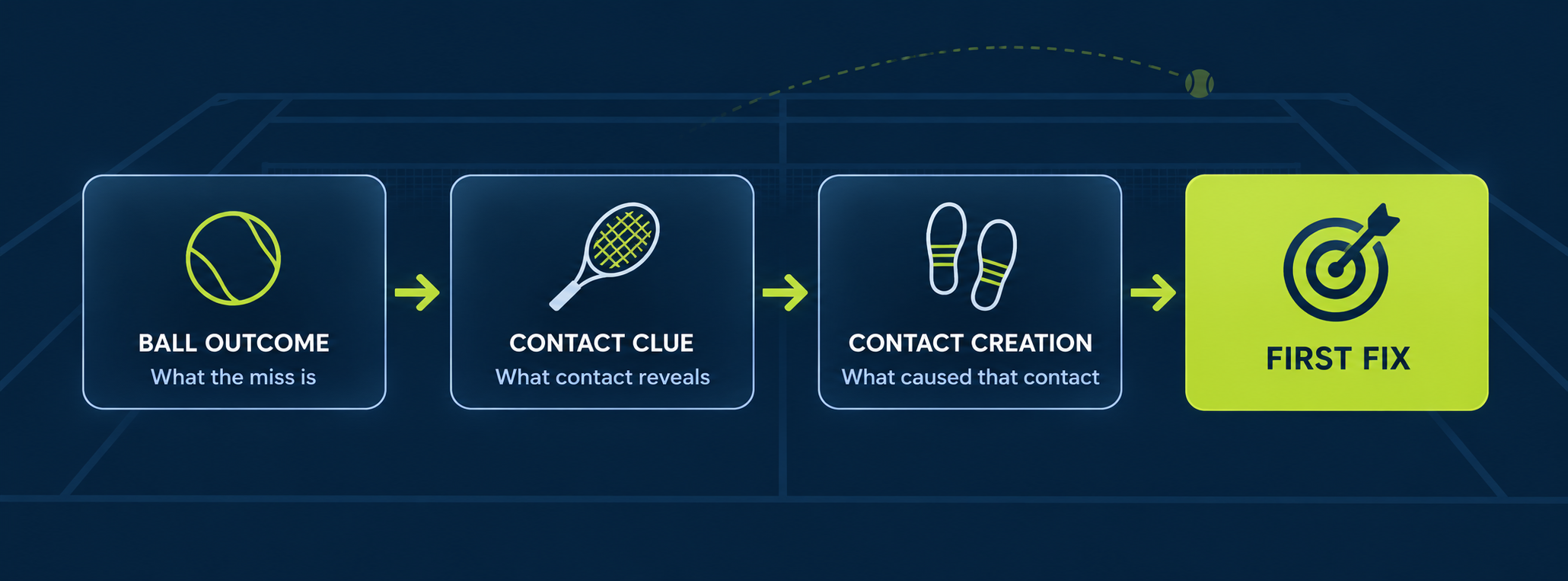
Most coaching starts and stops at the ball. I do not think that way. The miss is the result of something that happened earlier, and that is where I look.
Ball flight gives me the clue. From there I want to know what contact created it, and what created that contact. That is how I find the broken link.
I would rather give you one thing that changes your game than twenty things that change nothing. Order matters more than volume.
When I watch a player, I am not collecting a list of flaws. I am working out which of these four phases is costing them the most points, because that is the one worth working on first.
Foundation
I look at whether your contact repeats.
When the miss moves around from week to week, the foundation is the first place I check.
Shield
I look at what you do when the ball will not come to your favorite spot.
This is where most matches quietly get lost, so it is a place I pay close attention.
Sword
I look at whether your shots make your opponent uncomfortable.
If the ball keeps coming back to a settled opponent, you are working harder than you need to.
Mind
I look at how you read the rally.
Knowing when to reset, when to build, and when to attack is a skill, and it can be trained.
If your contact is compromised, reset the point. If the rally is level, build. If your opponent is in trouble, that is when you attack.
Most players work on the Sword while their Foundation is leaking. Finding that order for your game is the part I help with.
I am not going to hand you a folder of tips and wish you luck. Here is how the work actually goes when we start.
Start with the TTD Game Leak Diagnosis. You answer questions about your game and I review your answers to find the biggest thing costing you matches.
You get one clear first focus, not a list of twenty fixes. You know what to practice and why it matters.
You are not doing this alone. Post your focus in the community, report what happened in practice or a match, and refine it with support.
I did not learn this from a book. I learned it by living every layer of competitive tennis, then watching adult players make the same mistakes I used to make. That is why I care more about finding your problem than adding to your collection of tips.
“My forehand is now consistent and reliable... Kevin has become a voice in my head that I can hear during a match”
 Kelley
“Every single time I've asked Kevin a question or shown him film, he nails it on the head immediately”
 Jason
Jason
“You were basically like a doctor... the fifth or sixth thing was the real issue. I had a plan of attack that I was confident in”
 Chris
Chris